Friday, October 27, 2017

Photos on Friday: Autumn sunrise in Shenandoah National Park

With October quickly slipping away, I realized we hadn't made our annual fall trip to the Shenandoah National Park. In recent years we had been heading to the park more often during the summer months to see the butterflies and wildlife, however, we like to at least try to see the beautiful foliage at least once. We made what is likely to be our last trip of the year to the park last weekend. Decided the day before to make it an early day and get out there before sunrise.

We just about made it to Mary's Rock Tunnel (a hop, skip, and a jump past mile marker 32) when we began to see glimpses of daylight, which was perfect since I was hoping to stop at the overlooks between here and mile marker 36 for the day's trip. Here are some photos we captured in that stretch of Skyline Drive.

This was taken a few minutes after we arrived. That white spot next to the tree we believe is Venus after checking Google Sky. It was shining very brightly that morning.

We were the second car to arrive, within minutes several other cars pulled up to enjoy what looked like was going to be a spectacular show.
And here comes the sun! At this point we had moved a bit further south.
A few minutes later

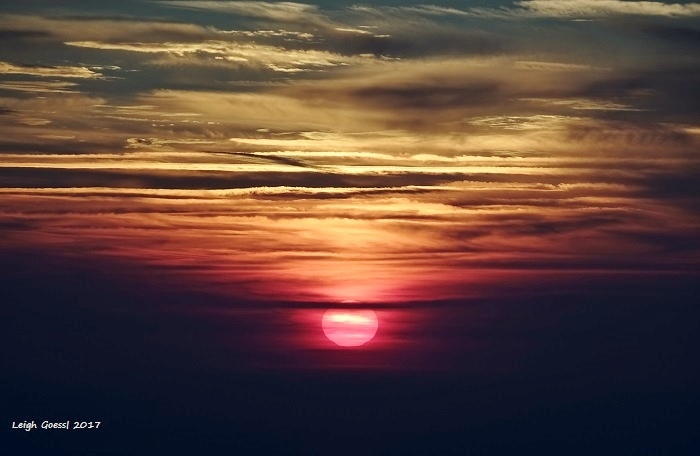
Peaceful morning in the mountains. We parked in a lot across the street at one of the gaps and stood on a rock wall to watch the rest of the sunrise. 


Monday, October 23, 2017

15 interesting facts about the Basilica of the National Shrine of the Immaculate Conception

Beautifully situated in the Northeast quadrant of Washington, D.C., the Basilica of the National Shrine of the Immaculate Conception attracts thousands of people each day. The National Shrine is the largest Roman Catholic Church in North America. 

Interested to learn more? 

15 interesting facts about the National Shrine


1. In 1913 a national shrine was approved by Pope Pius X to be built in the United States. The cornerstone for the Basilica of the National Shrine of the Immaculate Conception was laid in 1920. The Crypt Church was completed in 1926 and the rest of the Crypt Level was finished in 1931.

2. The Church is Romanesque-Byzantine style and is made entirely of stone, brick, tile and mortar. There are no steel structural beams, framework or columns found in this building. It was believed the Romanesque-Byzantine style fit in well with the other architecture found in Washington, D.C. 


3. Several architects were involved with this major project. From the 1919-36 construction, they were: Maginnis and Walsh of Boston, with associate Frederick V. Murphy, Professor of Architecture at CUA, Timothy F. Walsh of Massachusetts, and Frederick Vernon Murphy. Post-WWII, the architects from 1954-59 were, Maginnis and Walsh and Kennedy of Boston, Charles D. Maginnis of Massachusetts, and Eugene F. Kennedy, Jr., also of Massachusetts.

4. The first Mass was held in 1924, on Easter Sunday.


5. Construction for the National Shrine was ongoing but was temporarily put on hold during the Depression and World War II. Build for the Great Upper Church superstructure resumed in 1954 and was completed in 1959. Its dedication took place on November 20 of that year.

6. Pope John Paul II was the first reigning Pope to visit the National Shrine; this took place in 1979. He would later elevate the National Shrine to the status of minor basilica in 1990. Pope Benedict XVI visited in 2008. He gave a rare bestowal of “a Golden Rose for Our Mother Mary”. This is an honor that dates back to the 11th century.

7. Every year about 1 million people visit the Basilica of the National Shrine of the Immaculate Conception to attend Mass, tour the church, or visit one of its many beautiful chapels. 


8. There are over 70 individual chapels to be found within the Basilica’s walls.

9. The National Shrine is more than 200 feet above sea level. Its exterior is 459 feet long, 240 feet wide, and the Great Dome’s diameter is 108 feet.

10. Seating capacity of the Basilica’s Upper Church is 3,500 people with a total capacity of about 6,000 people.

11. In addition to being the largest Roman Catholic Church in North America, did you know the National Shrine is also listed in the top 10 largest Roman Catholic Churches in the world?


12. The Great Dome features five Marian symbols: Fleur de lis, Cedar of Lebanon, Tower of Ivory, Star of the Sea, Intertwining Monograms of A and M (Ave and Maria).

13. The Knights Tower is 329 feet tall and has a 56-bell carillon

14. Bishop Thomas J. Shahan, the National Shrine’s founder, is buried in the Founder’s Chapel, located in the Crypt Level. He is the only person buried in the Shrine.

15. The Basilica is often referred to as “America’s Church”.

If you are Catholic or of another religion, this is a wonderful place to visit with its spirituality, no matter your beliefs. Several Masses and Confessions are held daily in the Basilica. However, even if you aren’t religious, the amazing architecture and artwork found in and out of the National Shrine are simply amazing; the interior is stunning. You can self-tour or take a guided one.

The Basilica of the National Shrine of the Immaculate Conception is located at 400 Michigan Ave. NE, Washington, D.C. 20017. Parking is free and relatively easy to access. To take the Metro, use the Red line (Brookland/CUA station); it is a .04 mile walk according to Google Maps.

Sources:

Visit to the Basilica
Links from the National Shrine websites, here and here [PDF]

Tuesday, October 17, 2017

Interesting DC tours: U.S. Bureau of Engraving and Printing

Did you know you can take a tour of the U.S. Bureau of Engraving and Printing during your visit to Washington, D.C. and see how money is made? Perhaps one of the lesser-known tours, it’s a really cool one if you get the chance to do it. 


How to get tickets


During the busy spring and summer months, you’ll need to get to get tickets ahead of time (same day distribution). They are on a first-come, first-serve basis and can be obtained at the ticket booth located at Raoul Wallenburg Place, just outside of the Bureau. The booth opens at 8 a.m. and closes after the day’s tickets have been distributed. The first tour is at 9 a.m. and ends at 6 p.m.

In the fall and winter months, which is September to February, tours are offered between 9 a.m. and 2 p.m. and tickets are not required and you can head to the 14th St SW entrance for entry (check the Bureau’s website for exact dates/hours). In the event of inclement weather, delayed opening or early closure by the federal government, this does affect the facility’s tours.

Additionally, if you contact your Senator or Representative, you can also reserve tickets through their office. Contact your local Congressperson for details.


What to do


The entrance to the visitor’s center is located at 301 14th St SW. Plan to arrive about 15 minutes early. You’ll need to line up when your tour time is called. When your time slot is called, you’ll go through security. The usual items are prohibited like you’d find at the airport or other secured area. No food or drink is allowed inside. 

Gift shop
You are allowed to bring your camera and are free to use it in the visitor’s center and gift shop, but taking photos or videos of any kind are strictly prohibited during the tour itself. Don’t be tempted to take a quick photo with your cell, you will be escorted out of the facility. Also, if you have little ones, you can bring your stroller with you but not on the tour.

After you are finished going through security, you’ll be inside the Visitor’s Center. There are some exhibits to look at and some displays on the wall to read which highlight the history of U.S. currency. You’ll have a few minutes to take a look around before you head into the next section to watch a short video.


What you’ll see


The tour takes place above the production floor and you'll go through the different sections, seeing how the denominations of U.S. money are made each step of the way. 
  • See literally millions of dollars at once
  • Hear the whirring of the machines and watch the currency go through each process of the printing
  • Learn about the measures added into money to prevent counterfeiting 

The tour itself is about 45 minutes, so give yourself approximately an hour for the experience. After the tour, there is a gift shop you can peruse before you exit. You'll exit on Raoul Wallenburg Place facing the Tidal Basin.


Other things you should know


Tours are not offered on weekends, federal holidays, and is closed the week between Christmas and New Year’s.  In 2018, some of the process will be altered with construction going on. Check at the ticket booth or the U.S. Bureau of Engraving and Printing website for the most up-to-date information.

Saturday, October 14, 2017

Where to find Halloween and fall fun in the D.C. area

Hard to believe it’s already mid-October. That means the fall festivals, corn mazes, ghost tours, and other seasonal fun events have long been in full swing. It also means Halloween is right around the corner. 

Looking for something to do with the kids? Maybe some old-fashioned fun? Perhaps something a little ghoulish? Here are some ideas of the many things there are to do in the D.C. area to celebrate Halloween.

Boo at the Zoo

A perennial classic in the District, the National Zoo’s “Boo at the Zoo” event takes place one weekend every year. Featuring over 40 treat stations, pumpkin carving demos, “scary-oke”, and other entertainment. Kids get all sorts of goodies at the treat stations, but the zoo hasn’t forgotten the adults. They are offered food and craft beer tastings. Check the zoo’s website for dates, times, entertainment, and admission prices for the current year.

District Wharf


Having made its debut in D.C. during fall 2017, the District Wharf opened with new restaurants, shopping, entertainment, and one-stop family night out. It looks as if they’ll be offering various special events throughout the year. In 2017, “Pumpkin Palooza” is being held. See the headless horseman, enjoy pumpkin-themed activities, such as pumpkin bowling, pumpkin pie-eating contest, pets’ costume contest, live music, and more. It’s too early to say whether or not this will be an annual event, but chances are there will be some family-friendly event offered.  


Update Oct. 2018: I don't see this event on the current calendar. Maybe next year?

Update Sept. 2019: Looks like the calendar changes from year to year. Check the Wharf’s website to see what’s on their schedule.


Trick-or-Treat at Mount Vernon


A newer tradition at Mount Vernon is trick or treating with other “spook-tacular” activities. The kids can wear their costumes (there is a contest for best George and Martha costumes with prizes), participate in a parade around the mansion and go trick-or-treating. Other fun includes a wagon ride, special scavenger hunt, and crafts. Visitors can also enjoy 18th-century entertainment and watch demonstrations highlighting life in Colonial days. See Mount Vernon's website for current dates and times. Event takes place rain or shine.  


Fall festivals at historic properties


Many of the area'
s historic properties offer family fun during October. I invite you to check out my post highlighting some of the perennial events you can find in the region. Celebrate the season and learn some history in the process!


Family fun on the local farms


Northern Virginia has many farms that convert their fields to fall family fun. Each farm offers something a little different but some of the attractions include pumpkin picking, hayrides, giant slides, corn mazes, and much more. I’ve explored several the farms (this post goes into far more detail about family fun on the local farms) but I know there are others and that’s without even looking into Maryland.

Looking for something else? Maybe a ghost tour? I have a post that outlines all sorts of cool events highlighting numerous family fun events (and some freakishly-scary stuff!)

See what's planned across the region. Additionally, the Fairfax County Park Authority offers numerous fall family fun events throughout the county (many of these events require registration).  

Happy Halloween!

Friday, October 13, 2017

Photos on Friday: Scouting out nature in Shenandoah National Park

Over the summer we took a few trips out to the beautiful Shenandoah National Park to do some hiking and try to scout out nature. Most of the time, we stay close to Skyline Drive, stopping at the overlooks and/or taking some short excursions. Today's photos on Friday highlights some of what we saw.


In the past, we've reserved these trips for the fall foliage, but last year discovered the summer beauty of the park. I was stunned by the number of butterflies. Literally dozens in one small area and this was throughout the park. Amazing!


Up until this summer, I'd only seen an owl in the wild, just once and that was during a 5:30 a.m. walk in the dark hours in my suburban neighborhood. However, this summer we were lucky enough to see three!


And, finally, this year I really (and I mean really!) wanted to see a bear. Last year I caught a glimpse of a big one as it ran away and didn't see his face. My wish was fulfilled on two separate trips. In July, we had the good fortune to see a bear high in a tree. On the second trip we spotted another bear in a tree and upon leaving Big Meadows we spotted one almost right on the side of the road, so we pulled over.

Had to scurry away from this guy, this photo is a zoom from across a road. 

This one has a story to it (you can read here). Moral of that story though, don't get too close. Even though the black bears in this region don't aggressively go after humans, you still need to be cautious. We didn't expect the bear to turn and come closer to us but that's what happened. A bear's huff is pretty scary. We had attended a ranger talk last year where we learned how to act in a bear encounter and I quietly got away and crossed the street.

In this bear photo we are at a distance. This fella is way up in a tree and more afraid of us than we are of him. He heard us, ran to the tree, and scampered up.


Friday, September 8, 2017

10 fun facts about ‘Foamhenge’ at Cox Farms

The year 2017 marked the first of Foamhenge’s new home at Cox Farms in Northern Virginia. You might be asking yourself at this point, what in the world is Foamhenge? 

If you haven't heard of it and are wondering, it’s a unique piece of art which is a life-sized foam reproduction of the historic Stonehenge in England. 

Foamhenge in Natural Bridge Virginia

Where did it come from? Who created it? How did it end up at Cox Farms? If you're still wondering, read on.

10 fun facts about Foamhenge


1. Foamhenge was built in 2004 by Rockbridge County-based artist Mark Cline of Enchanted Castle Studios. For more than a decade he maintained the unmarked, yet very popular, site which was located in Natural Bridge, Virginia.

2. Cline originally designed and built Foamhenge as an April Fool’s Day stunt. Cline has told the media he never thought it would last more than a year. Instead, it lasted for 12. And it wasn’t dismantled out of lack of interest either (the attraction gained a sort of a cult following over the years), it was a forced removal which took place in late August 2016.

3. The pieces that make up Foamhenge are made of beaded foam and weigh approximately 420 pounds.

facts about Foamhenge
Some pieces of Foamhenge

4. Foamhenge was built by a small group of men and took six weeks to build. Cline was meticulous to ensure Foamhenge was an exact replica of Stonehenge, doing research to see that it was astronomically correct. 

5. The foam was delivered from Winchester, Va. to Rockbridge County by tractor-trailer – it reportedly took four trips!

6. Over the years many people traveling through Virginia stopped at the Natural Bridge exit in search of seeing Foamhenge in person, myself included. I learned about it almost a decade into my Virginia residency. I made a stop to see it six months after I first heard about it. At the time, I didn't know it, but Foamhenge was literally in its last days at its original home at the Natural Bridge. 

7. Despite no advertising, signage or anything indicating the big foam pillars stood just off the roadside, up a hill and behind some trees, Foamhenge ended up being featured on The Discovery Channel, Smithsonian Channel, TBS and MSNBC (and the Zippy the Pinhead comic strip too). Not bad for something that was originally a gag! Turned out Foamhenge was really good for local tourism. 

Foamhenge
At the old location, a short walk up the hill to Foamhenge

8. A Merlin statue stood at the original site watching over Foamhenge. 


9. Foamhenge was moved in late 2016 as the property it sat on was designated to become part of the new Natural Bridge State Park, which also had formerly been privately owned. Officials gave the reason that Foamhenge did not “fit” with Virginia’s state parks’ mission.

10. After many interested parties from various places in the United States expressed interest in acquiring the unique landmark, Cline ultimately decided to send it to Cox Farms. Cox has since moved it to its property in Northern Virginia.

Foamhenge and Merlin

There you have it – 10 fun facts about Foamhenge. If you want to see Foamhenge in person, you can see it at Cox Farms, which is located in western Fairfax County. 

Cox Farms is a popular destination for locals and tourists, especially known for its’ phenomenal fall festival and Fields of Fear. Foamhenge made its debut at its new home on Sept. 16, 2017. It's available for visitors limited time frames during the winter, spring and summer (check the link above) but the ability to tour Foamhenge is included with admission to their fall festival.

Thursday, September 7, 2017

16 fun facts about the John F. Kennedy Center

The John F. Kennedy Center for the Performing Arts is a vast cultural center that is wholly dedicated to the performing arts. A highly visible building as you drive over the Potomac River on any one of the bridges from Virginia into the District, the center is one of D.C.’s top venues to see performing arts.

front view of the Kennedy Center
Partial view of the front exterior of the Kennedy Center

The DC Kennedy Center welcomes millions of people each year to enjoy a show, learn something new or to simply explore the building and what it has to offer. Want to know more?

16 facts about the John F. Kennedy Center for the Performing Arts


1. The Kennedy Center is located on 17 acres and was designed by architect Edward Durell Stone.

One side of the rooftop terrace at the Kennedy Center

2. President Dwight D. Eisenhower signed legislation (the National Cultural Center Act) in 1958 to establish a building dedicated to the performing arts. A few months prior to his death, President John F. Kennedy had signed legislation to expand the newly designated cultural center which increased the number of trustees and extended the time for raising private funds. The Eisenhower Theater in the Kennedy Center sits 1,164 people and is named in President Eisenhower’s honor.

3. The newly-designated center was renamed as a national living memorial to President John F. Kennedy following his 1963 assassination. President Lyndon B. Johnson signed the bill on January 23, 1964. 

4. At the groundbreaking ceremony in December 1964, President Johnson used the same gold-plated shovel used for the groundbreaking ceremonies of the Lincoln and Jefferson Memorials.

5. Opening night for the John F. Kennedy Center was on Sept. 8, 1971. The world premiere that evening was Leonard Bernstein’s “Mass: A Theatre Piece for Singers, Players and Dancers” and was performed at the Opera House.

6. The Hall of States showcases a bright display of 50 flags, each representing one of the states. They are hung along the ceiling in the order they entered the union. U.S. territories and District of Columbia flags are also displayed.


view of the Hall of States, Kennedy Center, Washington DC
Hall of States


7. The Hall of Nations also displays flags. In this grand hall, you can see flags from all of the countries with which the United States maintains diplomatic relations.
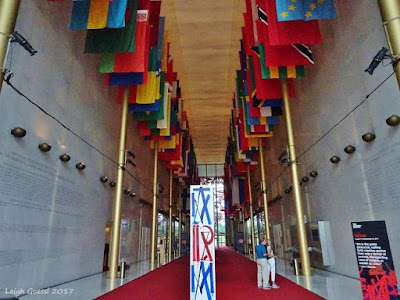

Inside of the Kennedy Center Washington DC
Hall of Nations

8. An impressive 630 feet long, 40 feet wide Grand Foyer showcases 16 Orrefors crystal chandeliers. Each chandelier weighs one ton.

9. President Kennedy is honored by a bust made by Robert Berks; it weighs a whopping 3,000 pounds.

10. The center’s Concert Hall has more than 2,400 seats.

11. The Opera House at the center, with its more than 2,300 seats, is illuminated by Lobmeyr chandelier, a gift from Austria. Its diameter is 50 feet and has almost 2,000 light bulbs!

12. Free performances can be found at the center’s Millennium Stage at 6 p.m. every day. A variety of art forms can be seen, including but not limited to dance, comedy, improv and various types of music.

13. Other performance spaces in the Kennedy Center include the Family Theater (324 seats), Terrace Theatre (490 seats), Theater Lab (388 seats), the North and South Plazas and the Terrace Gallery.
14. Visitors are able to roam the River and Roof Terraces and take in the views of the city and of Northern Virginia. Highlights include the Lincoln Memorial, Jefferson Memorial, Washington Monument, Washington National Cathedral, the Pentagon and Arlington National Cemetery. Boats, kayakers and other water travelers can be watched going up and down the Potomac River.

View of NW DC and to the left is Virginia

15. Along the River Terrace’s marble walls, you can read engraved quotes by President Kennedy that was said with emphasis on the arts in American culture.

16. The Kennedy Center is currently undergoing a massive renovation. Its first renovation since its build, the Kennedy Center will see three pavilions: A Welcome Pavilion, Skylight Pavilion, and a River Pavilion. The new spaces will add studios, rehearsal rooms, classrooms, lecture hall and other spaces dedicated to education. There will also be a large outdoor wall for video presentations, along with a cafĂ©. 

Existing cafe inside of the Kennedy Center
As a long-established and highly acclaimed DC performing arts center, over 3 million people visit the John F. Kennedy Center each year. Visitors are welcome to the center to visit and free tours are offered daily.

Sources:
Personal observation
Brochure and booklet picked up at the John F. Kennedy Center for the Performing Arts
Kennedy Center website