Thursday, May 12, 2016

6 of the best kept secrets in Northern Virginia

The greater Washington DC Metro area includes Northern Virginia and there are plenty of things to see and do in NoVa. Well-known attractions, such as Mount Vernon, the Pentagon, Manassas Battlefield and the Smithsonian National Air and Space Museum's Steven F. Udvar-Hazy Center, are popular destinations (and rightly so), but did you know there are some real jewels sandwiched between and/or just beyond some of these major tourist attractions?

Not that these sites are any true secret, mind you, but they are probably a little less-known than some of those larger historical sites and museums. And these gems are definitely ones worth checking out.

1. Stabler-Leadbeater Apothecary, Alexandria

Located in the Old Town section of Alexandria, the Stabler-Leadbeater Apothecary is one of my personal favorites. It is a museum that showcases history, business and socio-economic trends spanning an amazing 141 years. Opened by the apothecary’s founder, Edward Stabler, in 1792, this business operated consecutively by the same family until its closure in 1933. 
Old Town Alexandria, Virginia
Inside view of the apothecary's store. You also get to see upstairs where the behind the scenes work was done too when on your tour

The fact the family simply locked the doors and walked away, leaving everything as is, makes this museum even more amazing. The history shared and the items displayed in this museum are just beyond cool. To learn more about the Stabler-Leadbeater Apothecary, I invite you to check out my detailed post about it.

While in Old Town Alexandria, there are other many fab places to check out too. A great city to explore and very close to Washington, D.C.

2. Fauquier History Museum, Warrenton

This is an interesting one – I stumbled across this gem while poking around online one summer day looking for things to do with the kids. The museum is built around the fact it was once an early 19th century jail that was operational for more than 150 years, closing in 1966. Built in 1808, it was expanded in 1824 and it’s interesting to see both original buildings. The 1808 building was adapted to house a jailer and his family.
Old Jail Museum, Warrenton, Virginia
Exterior shot of the Fauquier History Museum before its name change

Formerly known as the “Old Jail Museum”, it’s easy to see why its name was changed. While the main attraction is probably the jail for most visitors, the original building showcases the 1824 kitchen and the other rooms have been converted into museum rooms. These rooms share a lot of U.S. Civil War and other interesting local history, including a fully-stocked 1920s dentist office.

I’ve only been to the Fauquier History Museum once, but it’s on my list of places I want to visit again.

3. Chapman's Mill, Broad Run

Over the years this structure has fascinated me as I could see it driving west on I-66, but didn’t see an easy way to get there. I had no idea what this fabulous stone structure was called or if it was open to the public. An online search told me it was Chapman’s Mill, also known as Beverley Mill (named for later owners). Armed with that information, I was able to plug in an address into GPS and actually get there. 

Beverley Mill and Beverley Store
Chapman's Mill and the Beverley Store (May 2016)

Located on the border of Prince William and Fauquier Counties, if Chapman’s Mill could talk, it would certainly have a lot of stories to share. Built in 1742 and having survived and operated until the mid-20th century (even after being burned during the Civil War), it has an amazing history.

Chapman’s Mill is currently undergoing restoration. It’s wonderful to see this gem is being preserved. I have written a couple of posts about the mill, here is my most detailed one with lots of additional photos.

4. Sully Historic Site, Chantilly

Dating back to 1794, Sully Plantation has an interesting history. Originally owned by Richard Bland Lee, Virginia’s first congressman, this property almost was demolished to expand the Dulles Airport. Fortunately, it was saved in the 1950s and has been preserved for the public to enjoy. Run by the Fairfax County Parks Department, Sully Historic Site has a lot to offer, including a ton of terrific themed events scheduled throughout the year. 
Sully Plantation
The Sully House

I went back for a tour in late March, which was excellent. I’d been through the house many times, but usually during a themed event and this most recent experience was a little different because the day was totally focused on the site itself, not the happenings around it. This was the second time I’d been on a full tour and really enjoyed learning more about the house and the families that lived in it.

If out visiting the aforementioned Steven F. Udvar-Hazy Center, the Sully Historic Site is also conveniently located off Route 28 and is just a hop, skip and a jump from the popular Smithsonian museum. Very easy to get back and forth between the two sites.

5. Museum of the Shenandoah Valley, Winchester

Winchester is one of those cities I’m near often enough, but usually passing through. I really need to set aside some more time and explore it properly. We met our friends out that way in December 2014 and enjoyed every place we visited, despite the heavy rains that day. 

Museum of the Shenandoah Valley
Photo taken in December 2014 - Pic is of one of the walls in a large exhibit called "Second Time Around: The Hubcap as Art". This showing lasted a couple of months - great stuff!

One of our stops was the Museum of the Shenandoah Valley. Whether you love art, history or both, there are a lot of interesting exhibits and collections to see. Some of the exhibits are permanent, others are special and only opened for a limited time. According to the museum’s website, there are 11,000 in MSV’s permanent collection. From the furniture to the dollhouses to the dishes to the paintings, there is just so much to see. I definitely want to go back during the warmer months and see more of this wonderful place.

6. Hotel Strasburg, Strasburg

Located approximately 90 minutes east of the District, the Hotel Strasburg was a great getaway for us a few years back. The building was constructed in 1902 and was once a hospital. Today, it is a historical landmark in the picturesque Strasburg and is restored back to the Victorian Era.

Dining room at Strasburg Hotel
One section of the dining room at Strasburg Hotel
During our stay, it wasn’t a terribly busy time of year and many of the doors to the rooms were ajar, allowing us a peek in as we passed by. From what I can tell, each room had its own uniqueness, furnished with antiques, which further added to my intrigue. If traveling out this way or just looking for a place to spend a night or two, I’d recommend it, for the D.C. area, the prices were quite reasonable when we booked. The restaurant was very good too (despite the hotel itself being rather quiet, the restaurant seemed to be a hot spot in town, it was very busy!)


To be honest, I had a realllly hard time narrowing this post down to just a handful of sites. There are just so many smaller historic sites, museums, and parks located throughout the Northern Virginia region. Many of which I haven’t visited – and several I probably haven't even discovered – yet. Hope to rectify some of that this summer and do lots of exploring!

Friday, May 6, 2016

Photos on Friday: 'Multiverse' light tunnel at National Gallery of Art


The Smithsonian’s National Gallery of Art has a lot of amazing things in it, but one thing I’d never heard about was the underground tunnel that links the east and west wings of the museum.

Named “Multiverse”, the tunnel is a light sculpture created by Leo Villareal, an American artist. According to the National Gallery of Art’s website, the work is comprised of about 41,000 computer-programmed LED lights. The work to build this interesting walkway began in 2005 and was installed in late 2008.

Today visitors can walk between the two wings in either direction. It's a cool experience, we went back during spring break and did it again. These photos are from this past February.

Multiverse light tunnel at National Gallery of Art


Multiverse light tunnel at National Gallery of Art

Multiverse light tunnel at National Gallery of Art

Tuesday, May 3, 2016

10 fun facts about the Eisenhower Executive Office Building

There are many cool buildings located in the heart of Washington, D.C. From the magnificent monuments located on the National Mall to the U.S. Capitol to the White House to the numerous government buildings - there are a lot of buildings around town with unique and/or interesting characteristics.

Photo of the rear of the Old Executive Building, I was at the Tidal Basin and zoomed in from this distance

One of my favorite buildings is the Eisenhower Executive Office Building. Located next door to the White House, this building is generally not open to the public (unless you know someone and can go as a guest) but visitors can come view its magnificent exterior.  


Old Executive Office Building
Front of the Eisenhower Executive Building

Not familiar with this building? Or even if you are, here are some fun facts you may or may not know about the Eisenhower Executive Office Building.

1. The Eisenhower Executive Office Building (EEOB) was designed in French Second Empire style. It took 17 years to build. Construction commenced in 1871 and was completed in 1888. It was designed by Alfred Mullet, Supervising Architect of the Treasury.  At the time of completion, it was the largest office building in the District. It cost $10,038,482.42 to build. It is located directly next door to the White House’s west wing.  

2. In the original build, there were 553 rooms, 900 exterior columns, 1,314 interior doors, 1,572 exterior windows, 4,004 bronze stair balusters, 1,784 steps and 151 fireplaces. 

Outside the Old Executive Office Building

3. Initially, the building was erected to house the State, War and Navy Departments. These departments began to exit the EEOB in the early 20th century. Fast forward almost a century and today the building serves a different purpose – it primarily houses White House staff.

4. After it was built, not everyone was appreciative of its elaborate design. It has been referred to as a “monstrosity” and writer Henry Adams called it an “architectural infant asylum”. 

EEOC in Washington DC

5.  In 1949, the building was given to the Executive Office of the President and renamed to be the “Executive Office Building”. Today, the building is also known unofficially as the “Old Executive Building” as many people in the region still refer to it by that name.

6. There are almost two miles of black and white tiled corridors inside the building. To minimize damage from fire, most of the interior detail is of cast iron or plaster, not wood. 

7. The departments moved into the building in stages. The first to arrive was the State Department in 1875. In 1879 the Navy Department moved in, followed almost a decade later by the War Department. 

Eisenhower Executive Office Building - Washington DC

8. Many of the United States’ most celebrated national figures spent time in the EEOB. Seven presidents had offices in its elaborate interior before taking office – Theodore Roosevelt, Franklin D. Roosevelt, William Howard Taft, Dwight D. Eisenhower, Lyndon B. Johnson, Gerald Ford and George H.W. Bush.
9. Many modern-era Vice Presidents have had offices in the EEOB. Seems to make sense being most staffers work there and its close proximity to the White House.
10. Set for demolition during the 20th century (reportedly, three times!), it ultimately was not torn down and and was designated a National Historic Landmark in 1969. It was subsequently listed on the National Register of Historic Places in 1972. 

Eisenhower Executive Office Building (EEOC)
If the inside, which I have heard is stunning from someone I know who has been inside, is as interesting as the outside, it must really be something to see. I've plugged into Google and have seen some interior photos; this is one building I'd love to see.

The EEOB is located at 1650 Pennsylvania Avenue Northwest, Washington, D.C. 20502.


EEOC, Washington DC

Monday, May 2, 2016

10 fun facts about Carlyle House in Alexandria

Carlyle House has a rich history in Alexandria, Virginia. Built in the mid-18th century, if its walls could talk, it would most likely have some interesting tales to tell about things seen and heard. 

Today the home is a museum located in the Old Town section of Alexandria and its history is shared with the public through tours.


Front view of Carlyle House

10 fun facts about Carlyle House


1. The home was built by a man named John Carlyle. Carlyle was a British merchant and one of the original settlers in Alexandria. He was influential in helping to develop Alexandria into the thriving town it became. Carlyle purchased the property in the late 1740s and began building the home for his bride, Sarah Fairfax, in 1751.

Carlyle House, Alexandria, Virginia
Mr. and Mrs. Carlyle greet guests and answer questions at a living history event in December 2015

2. The home is situated along the Potomac River, the perfect location for a merchant. It is built of stone (the only one of its kind in Alexandria) and in Georgian Palladian style. It is considered to be very innovative for its time as, unlike other homes built during this era in America, Carlyle’s house was modeled after European homes of distinction and designed to reflect his family’s Scottish heritage. He finished building the home in 1753.

Carlyle House, Alexandria, Virginia
Standing between floors on Carlyle House looking down into the central hallway. In Colonial times, this would have been an important room with many gatherings taking place. Back in those days bright colors usually signified wealth.

3. The Carlyle home was an important hub, socially, and for business. Many well-known figures spent time in the house as Sarah also came from a prominent family. The home is also well-known for a specific meeting held at the house in 1755. It was at this time General Edward Braddock, the Commander-in-Chief of His Majesty’s Forces in North America, called a gathering with five Colonial governors. The purpose of this meeting was to plan for the upcoming French and Indian War. Carlyle was reportedly not pleased with this but recognized the significance.

4. Did you know Carlyle House almost didn’t survive? Over the years heirs had sold off bits and pieces and the property began to deteriorate.

Carlyle House, Alexandria, Virginia
Dining room at Carlyle House

5. In the early 19th century the home left family hands completely and, through the decades, fell into terrible disrepair. During the rest of the 1800s, the property changed hands a few times with many people moving in and out of the home.

6. In 1847-48 a man named James Green began reassembling the original Carlyle property. He purchased the home and three quarters of an acre of land. Green also purchased a bank to convert and further expand into a luxury hotel. This hotel, named the Mansion House Hotel, blocked a large portion of the original manor home from view. 

Mansion House Hotel Carlyle House
The Mansion House Hotel mid-19th Century. Image credit: Wikipedia

7. During the Civil War, Carlyle House was established as Union Army headquarters and the hotel was used as a hospital. Later, in the 20th century, Green’s hotel became an apartment building and the house deteriorated even more. During WWI the home was designated to be a museum, but it would take many decades for it to be restored to its former glory.

8. The Northern Virginia Regional Park Authority acquired Carlyle House in 1970 and saved it from ruin. The hotel/hospital was torn down to allow the home to be visible and the grounds re-established.  NVRPA fully restored the former elaborate manor in time to be ready for the nation’s 1976 Bicentennial celebration. Today, the house looks beautiful and visitors can experience the home as it existed during the Carlyle era. 

Carlyle House, Alexandria, Virginia
Main bedroom at Carlyle House
9. One of the rooms in Carlyle House has not been restored as the others have been. Instead, visitors can see the original architecture and construction over the years in the various “layers” that can be seen in one of the upstairs rooms. From an architectural and historical perspective, I’ve always found this room very interesting to view.
Carlyle House, Alexandria Virginia
Each wall shows different attributes of how the home looked at different stages. Visitors literally view layers of history in this room.

10. There are a number of reenactments that take place during the year at Carlyle House that represent and highlight specific times in history that are connected to the home. These are fun to attend and learn more about life in those times and the events surrounding the people who lived there. Carlyle House is also a popular wedding venue.

Located at 121 N. Fairfax St., in Old Town Alexandria, visitors are welcomed to tour Carlyle House and learn more about this time frame in early American history. There is a nominal admission fee, check the museum's website for current tour times and admission prices.

Fun things to do in Washington DC on July 4


Summer in Washington is a sizzling time, and not just for the seasonally warm temperatures we typically see. Every year people head to the U.S. Capital to see the sights and experience all there is to offer in this historic city. 

The District offers many things to see and do at any given time of the year, but come Fourth of July, special events are planned throughout the day. There are a number of wonderful celebrations commemorating America's birthday.

 
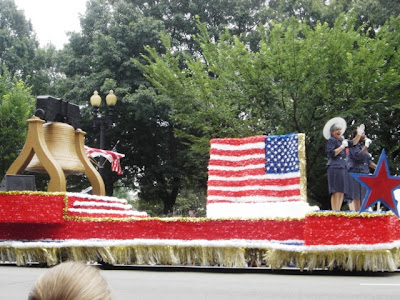
Float in July 4 parade in Washington DC


National Independence Day Parade


Every year on July 4, the National Independence Day Parade takes place. All along Constitution Ave., between 7th to 17th Street, thousands of people line up to watch the parade. The parade commences at 11:45 a.m. each year, and spectators watch bands, military units, floats, balloons, VIPs and other celebrity participants, in a wide display of red, white and blue.

National Independence Day Parade


National Independence Day Parade


This parade is something to see. You definitely want to arrive early to get a good spot! The streets get very crowded for this one. 

National Archives ceremony


Every year crowds gather at the National Archives to celebrate the anniversary of the Declaration of Independence's adoption. 2018 marks its 242nd year. To commemorate this significant event, on the morning of July 4, there is a reading of the Declaration of Independence by historical reenactors, accompanied by patriotic music. This event begins at 8 a.m. and runs until 11 a.m. when visitors can then turn their attention to watch the parade.


After the ceremony, there are family fun activities planned from 11 a.m. to 4 p.m. Visitors to the National Archives can also have an opportunity to view the original copy of the historic document. The National Archives building is located on Constitution Ave. NW, between 7th and 9th Streets. Seating for the event is first come, first serve basis.

Baseball Game at Nationals Park


If baseball is your thing, a day at Nationals' Park is another option. Home games for the Nats are traditionally scheduled on Independence Day, usually with an 11:05 a.m. start time. 

Nationals Park Stars and Stripes Series


Fireworks/Concerts


After the day events come to a close, the city continues to celebrate with an annual concert and fireworks show. This show is typically a televised broadcast across the nation. The concerts always feature popular celebrities and the fireworks are spectacular. To be honest, I've always left downtown after the daytime activities as it is crowded and seems to get even more so as the day goes on, so I don't have advice here, however, the National Park Service offers some tips for attending.  

Of course, most, if not all, of the year-round and summer attractions are always an option, many of them free of charge. The District has plenty to offer including the monuments, many museums, river cruises, water sports and other events.

It is important to note that due to heightened security, getting into the National Mall for any of the events will require going through a security check. Additionally, July in Washington is typically very warm, so dress appropriately, wear comfortable shoes and plan to drink lots of water.

Friday, April 22, 2016

Photos on Friday: Moonlight views of the Washington Monument

Visiting Washington, D.C. is great any time of the day, but the moonlight views are really something. For today's Photos on Friday post I thought I'd share some photos I'd taken in March during an evening visit. The Washington Monument is very beautiful at night. Today's photos show it from different angles.

Viewing the Washington Monument at night
This photo of the Washington Monument and Reflecting Pool was taken while standing in front of the Lincoln Memorial

Viewing the Washington Monument at night
Standing at the FDR Memorial and looking over the Tidal Basin during peak cherry blossoms

Viewing the Washington Monument at night
Another view from the edge of the Tidal Basin showing the Washington Monument's reflection

Tuesday, April 19, 2016

Views of the pretty Virginia Bluebells at Manassas Battlefield and Bull Run Park

This year was the first time I'd heard of the Virginia bluebells. Reaching peak approximately mid-April each year, these flowers cover the forest floors in a sea of blue, pinks and purples. 


On Saturday morning, we took a ride out to Manassas Battlefield and walked one of the loops there to see the bluebells. Afterward, we headed over to Bull Run Park, which I had heard was spectacular, and explored a good portion of the flowers on that trail too. It was a really enjoyable few hours. We saw a few pinks and purples, but at this time most of the flowers were a full blue.

I was so glad a friend of mine mentioned the Virginia bluebells. How I missed hearing about these during the decade I've been here, I'm not sure as I usually love to check out anything having to do with flowers. 

It looks like we caught the bluebells just as the peak was just about ending, but there was still plenty of color. Here are some photos from that day: