Thursday, September 10, 2015

Throwback Thursday: History of the beautiful Oatlands Historic House and Gardens

This piece about Oatlands Historic House and Gardens was originally posted in June 2014 when I relaunched this blog. Today I'm republishing it as a "Throwback Thursday" post. 

I've been itching to get back to visit this property, was really hoping to go in May or June to see its gorgeous gardens, but unfortunately wasn't able to go. The property is great to visit at other times too. For instance, you can see this wonderful tree!


This is a unique tree located at Oatlands.

****************************************************************

Northern Virginia is closely tied to early American history. Across the region many original structures still remain, and are open to the public. Preservationists have done a remarkable job restoring and maintaining a number of properties. Oatlands, located in Leesburg (Loudoun County), is one such property. This plantation highlights 200 years of American history.


Mansion at Oatlands Plantation in Leesburg, Va.

History of Oatlands

Oatlands plantation was established in 1798 with almost 3,500 acres of prime farming property. Built by George Carter, a young bachelor who had inherited the property, the land grew to become a substantial piece of prosperous property, cashing in wheat crops. Carter was a descendant of one of the first families to come settle in Virginia from abroad. The Carter history in America began in 1649 when John Carter immigrated from Buckinghamshire, England (George Carter was born in 1777, the first of his family to be born in the newly named United States).

Construction of the home began in 1804 and the home was originally designed to be a classic Federal-style mansion, but mid-build was transformed to Greek revival style. It  wasn't finished for many years. Over the decades, Carter expanded his mansion and added the elaborate gardens. In the aftermath of the War of 1812, he turned his attention to business during the recession that commenced, rather than invest in the completion of the house. Although, the house was finally completed in 1835, it is theorized during the build time styles had changed, suggestion this as the reason why the design had changed mid-build.  

The house was designed differently as you can see looking upon the house from the rear

Carter never married until late in life, but in 1835 he wed Elizabeth Grayson Lewis, a widow. The couple went on to have two sons together. After Carter passed away, Elizabeth managed the property, along with her sons. The Civil War took a toll on the family's prosperity, as their wealth had been built using slave labor. After the war, the mansion was used as a girls' boarding school, and later, a bed and breakfast. In 1897, the family let the main property go, selling it to Stilson Hutchins, the founder of the Washington Post. Hutchins never actually lived at Oatlands and sold the property in 1903 to William and Edith Eustis, an affluent couple from Washington, D.C.


Bridging the 19th and 20th Centuries


With the Eustis family buying Oatlands, this bridges the history of the home from the 19th to the 20th century. William was an avid horseman, and his primary motivation to buy Oatlands as a secondary home was to have a base in Virginia where he could be near the social events and fox hunts in the region. His high interest in equestrians is very evident when you tour the house.

Bachelor's cottage at Oatlands, Leesburg, Virginia

Bachelor's cottage on Oatland's property, circa 1820. This building is not open to the public.

In one of the rooms, the connection to U.S. President Theodore Roosevelt is also highlighted. Edith and President Roosevelt had been childhood friends in New York's Hudson Valley, and maintained contact over the decades. This is noted on the tour. The Eustis' are also said to have acted as liaison to opening their Virginia home to Roosevelt meeting his mistress, Lucy Mercer, according to some accounts. The Eustis' restored Oatlands to its former glory, without making many structural changes, and Edith Eustis took it upon her mission to restore the once beautiful gardens. 

Reflecting pool in the gardens at Oatlands Plantation
Reflecting pool built by Edith Eustis in the 1930s

Gardens at Oatlands
The gardens at Oatlands are quite expansive

Gardens at Oatlands


With restoration and ongoing care, the gardens still bloom heartily to this day. After Edith's death in 1964, the couple's two surviving children donated the home, its furnishings and 261 acres to the National Trust for Historic Preservation. It was later opened to the public.


Touring the home and gardens


No photos are allowed to be taken of the inside of the home, but during the tour you'll see many period pieces, family paintings and photos that had belonged to both the Carters and Eustis families. The tour guides are informative and can usually answer questions about the home and history of the families. The restoration of Oatlands truly showcases both the 19th and 20th centuries, as parts of the house reflect the Carter era while others are clearly modernized, such as the upstairs bathrooms, showing how the Eustis' lived.

This article only touches upon the intimate and intricate relationships that are likely connected to this home. In early American history, many of the families reflected in the region have several ties that bind them to other prominent families and pieces of history. Today, the property is listed as a National Trust Historic Site and a National Historic Landmark, and, for a fee, tours of the house, property and gardens are open to the public. In addition to the house and gardens, there are other structures on the property where visitors can explore. The gardens, during the spring and summer months, are truly worth spending a lot of time in. 

chauffeur's house at Oatlands
Chauffeur's House at Oatlands. This structure is not open to the public.

greenhouse at Oatlands in Leesburg, Virginia
A glimpse inside part of the historic greenhouse at Oatlands

Smokehouse at Oatlands


I've taken this tour several times and will likely be returning again.

Former carriage house at Oatlands Plantation.
The former carriage house has been refitted to serve as a welcome center, gift shop and a space where Oatlands holds scheduled teas and other events. Oatlands is open seasonally from March until December 30. You can check the website for current prices, hours of operation and also explore to see what special events are taking place throughout the season.  

Related reading:
Interesting historic grand homes to explore in Northern Virginia

Thursday, August 13, 2015

Tips for using the Metro Lines in Northern Virginia


If you want to pick up the Metro in Northern Virginia, you have a few options because you can take the Orange, Blue, Yellow or Silver Lines. Taking the Metro is convenient because you don't have to worry about the car parking dilemma once you get to D.C., especially during special events.

Parking in general, special events or not, can be difficult and the free parking down by the monuments typically fills up quickly. It's more financially feasible to take the Metro in most cases rather than park in one of the pay parking areas in downtown D.C.

Here's a quick rundown of each Metro line and the stops you can access in Northern Virginia:

Blue Line: The Blue Line picks up in Springfield, the only station in Fairfax County, then runs to Van Dorn Street on the outskirts of Alexandria. From here it goes into the heart of Alexandria at King Street. From King Street the train continues through Alexandria at the Braddock Road stop to the Ronald Reagan National Airport, Crystal City, Pentagon, Arlington Cemetery and then at Rosslyn. From here the line turns and heads into Washington D.C. through to Maryland at the other end of the line at the Largo Town Center.

Yellow Line: The Yellow Line also only has one stop in Fairfax County and this is located at the Huntington Station. From here it turns into Alexandria and stops at Eisenhower Avenue, King Street, Braddock Road, Ronald Reagan National Airport, Crystal City, and Pentagon. At this point, the Yellow Line goes east and heads into Washington D.C. proper.

Orange Line: The Orange Line runs west in Fairfax County. The stops are located at Vienna (one end of the line), Dunn Loring-Merrifield, West Falls Church, East Falls Church, Ballston-MU, Virginia Square-GMU (George Mason University), Clarendon, Courthouse and Rosslyn. After Rosslyn, the rail crosses the Potomac River and you'll hit the Washington D.C. stops which then lead to Maryland and ends at New Carrolton, the other end of the line. A popular line being it crosses the Smithsonian Station stop.

Silver Line: Opened in July 2014, the silver line is still a work in process. Eventually, it will run out to Dulles International Airport, but currently the route is from Wiehle-Reston East to Largo Town Center. Basically, it shares track with the Blue and Orange lines, but hits different areas of Northern Virginia the existing lines do not reach.

There is also a Red Line, but this one runs through Maryland and D.C. There are several options for starting or ending your journey in Northern Virginia by Metro. The Orange, Blue, Yellow and Silver lines are pretty accessible and parking is available. Additionally, many Metro buses run to the various stations.

You can view the Metro Rail Map on the Metro's website to give you a better visual of all the stops in Northern Virginia, Washington D.C. and Maryland. This map includes the Red and Green Lines as well, which may help you navigate any train transfers you may need to take in order to get you closest to your destination.

Tuesday, August 11, 2015

Fun with the kids: Visiting the Leesburg Animal Park

If you're looking for a good time with the kids in Northern Virginia, Leesburg Animal Park is a great place to spend a few hours or the day. The park is located on a quiet highway in Loudoun County, Va., but is one of those places you're happy to find when you come across it.

The Leesburg Animal Park isn't overly large, but it does offer lots of stuff for the kids to see and do. Because of the high interactive component, I feel it is more impressive than some of the other animal parks you might see. Children are allowed to feed and pet most of the animals, although there are a few exceptions.

Some highlights of the Leesburg Animal Park:

Meet the animals


This animal park is pretty hands-on and visitors get a good chance to get up close and personal with the animals. There are two primary areas where animals who can be fed reside. One is located just inside the entrance gate and is comprised of wooden pens that the smaller animals wander in and out of, and the larger animals can poke their heads out.

The other area is just a bit further down (very close and stroller friendly) and is constructed as a large fenced in area. In this section the animals wander completely free. Visitors are welcome to go inside and have a true close encounter with many animals.

For the most part, the animals are extremely friendly, but some are aggressive as they nudge you for food, perhaps just being overly friendly. Kids either love or hate this part of the experience, it really depends on the child. If yours are afraid of animals being too “in your face”, you might want to let them watch the side rather than going into the fenced area. And if you are visiting with a little one who knocks over easily or is intimidated by animals, you may want to pick them when visiting this section of the park. 

Although, there are the less intimidating smaller animals in there too, such as baby goats which are typically a hit with the little ones. 

Exotic and domestic animals


There are also other animals which the kids cannot get up close and personal, but they can see other animals they likely don't get to see that often. There's lemurs, peacocks, macaws, and the amazingly large Aldabra tortoises. 

The gibbons are extremely playful and are a hoot to watch. There's even a porcupine! 

Play


There are several other neat things for the kids to do at Leesburg Animal Park. For
instance, there is a playground and moon bounce. Another fun activity is the tractor ride. A staff member pulls the group in a wooden wagon with a farm tractor. The ride is about 10 minutes to the back of the park. The wagon offers plenty of space and feels more like a real tractor ride than some other places we've been, complete with bumps and all.

Around the back are zebras where the kids can catch a look. After the zebras the driver makes a stop at the pond around back. As soon as the fish hear the motor they come in swarms followed by the ducks and geese. 

It is pretty amazing to see the fish jump all over one another as they anticipate being fed. The fish actually respond to the sound of the tractor arriving. The driver gives every rider some food to feed the ducks, geese and fish. The kids are bound to get a kick at of this aspect of the park.

This is incredible to watch
There’s also a new indoor play space. I’ve not seen it yet.

All of these activities are included with the admission price.

Pony rides


For an additional fee, smaller children (not sure of the weight limits on this, but pretty sure there is one) can have the opportunity to ride a pony. This section is located right near the animal pens and in very close proximity to all the activities.

There is a small gift shop on premises where you can buy light snacks. Picnics are welcomed on the premises and there are plenty of tables spread throughout the park to sit and enjoy your lunch. There's also a playground and plenty of open space for the kids to run about if they need to let off some steam.

To learn more about pricing and hours of operation, check out the Leesburg Animal Park website for more information. If you're in the Washington, D.C., Northern Virginia or Southern Maryland area and are looking for something a little bit off the beaten path, this destination might be just the place you're looking for to take the kids.

Side notes:

  • According to this year’s calendar, the park is closed on Mondays this summer

  • The Leesburg Animal Park is also located practically next door to the lovely Oatlands property

Friday, July 17, 2015

Summer fun in Washington DC (taking a break)

This summer is turning out to be busier than I thought! I'll still be posting, but it will probably be a little more sporadic than I have been in recent months. If you are looking for something specific that is going on in the area, many summer events in Washington DC and Northern Virginia I wrote about last year are perennial. If you'd like to find these, you can do a search in the box to the right of this blog.

Thanks for reading! Hope you're having a great summer.

A summer view of the U.S. Capitol (a couple of years ago) taken from the top of the Old Post Office building. 

Monday, July 13, 2015

Review: Monastery Creamed Honey is a Real Treat

Last summer I was exploring one of the local farmers markets in Northern Virginia and came across a product called "Monastery Creamed Honey". This creamed honey was made in Virginia and contained no artificial ingredients, so I took the advice of the farmer selling it and picked up a container. I wasn't sure which one to choose (there were at least 3 flavors carried at this market), so I went with the almond-flavored.

This honey was great! I usually buy traditional honey, and hadn't eaten a creamed variety in ages. When my almond honey ran out, the farmers market was over for the season so I  figured I'd have to wait until spring to pick some up. However, I had traveled out to Winchester in December and in one of the museum gift shops was a large supply of Monastery Creamed Honey with several other different flavors! I bought four containers. I picked up another container of the almond since it was so good and decided to try some new flavors too - I bought orange, raspberry and lemon.

 The orange is very good, the raspberry was a bit strong for my taste, but still enjoyed it. The lemon I haven't opened yet, but I am looking forward to trying it once I finish the containers I've already opened.

Other flavors I haven't bought yet include natural (plain), blueberry, cinnamon and brandy. I'll definitely be trying these in the future. The monastery is only about an hour from me so I'm sure I'll be able to find it locally. However, I also learned the monastery also sells honey (and many other food products) online.

I usually mix a 1/2 to 1 spoonful in Greek yogurt for breakfast or an afternoon snack. It has a buttery consistency so also goes great on toast, with crackers or pretty much anything you might want to mix in or add as a spread. I'm still exploring ways to eat it.The farmer told me its also good in tea.

(Confession: there have been times I've simply eaten a spoonful when I had a craving for something sweet).

The honey is made by the Monks of Holy Cross Abbey in Berryville, Va. It comes in a 10 oz container and costs approximately $7. You can learn more about their products on their website or by calling 877-264-6785 (toll-free).  They also take online orders or you can buy it on Amazon.

Friday, July 10, 2015

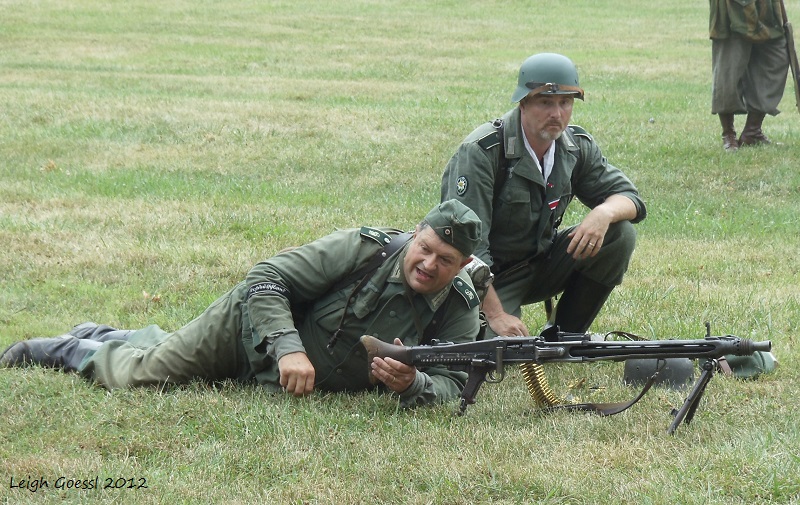
Photos on Friday: 'Action shots' from Sully Historic Site's WWII Weekend

Since tomorrow morning kicks off Sully Historic Site's annual WWII living history weekend event, I thought I'd dedicate today's Photos on Friday to some "action" shots I'd taken during a 2012 visit.

To learn more about Sully's WWII Weekend, I have a much more detailed post with some additional photos posted a few week's back you can find here.

Without further ado, here are the photos:


Wednesday, July 8, 2015

Civil War Encampment Weekend at Sully Historic Site

Every August the Sully Historic Site has its annual Civil War Encampment Weekend. Come watch and interact with re-enactors as they live out their lives during the war-torn years of the 19th century.

Visitors during this weekend will see firsthand how people lived, worked and/or served in one of the armies during this era. Living history participants will "skirmish" and you'll see infantry, artillery and cavalry as it existed in the 1860s. You can view and/or ask questions to learn more about this pivotal time in American history. See what encampments looked like and also experience live music and fashion of that era.

This year's event takes place on Aug. 15 (10 a.m. to 4 p.m.) and Aug. 16 (10 a.m. to 3 p.m.). The Civil War Weekend is one of a series of historic weekends and events the county-owned facility runs. These are all family-friendly events.

As customary with any of Sully Historic Site's events, a house tour of the property is also included in the price of admission. For the Civil War Weekend event, prices are $9 for adults, $7 for seniors and children.

Photos taken a few years back -we had a great day out.